This is a concept piece. Longwalk Dog Food Co. is a fictional Bristol dog food brand we use to show what a marketing system looks like when it is designed as one loop instead of four disconnected purchases. Every piece below is built and working, and the landing page is live to try. The campaign has not been run for a paying client, so the report at the end uses sample data and says so. If you sell a consumable, we scope and build your version of it. See what the marketing work includes.
A launch campaign for a fictional Bristol dog food brand, built around the question every consumable brand gets wrong in its first year: what are we actually buying when we buy an ad?
The usual answer is a first order. It is the wrong answer. A dog food brand selling a £42 bag does not make money on the first bag, because the ad that found the customer ate most of the margin. The business is decided by whether that customer buys a second bag a month later, and again after that. So the campaign was designed backwards from the second bag, and every piece in it exists to move someone one step closer to that repeat, not to the first checkout.
Why this shape
Dog food is the clearest case of a problem every consumable brand has. The buyer:
- Has a dog that already eats something, whether that is dry food from the supermarket, tins and pouches, or raw from the freezer
- Is not unhappy with what they feed now, only unsure it is the best they could do
- Will judge the whole brand on the first week, when the dog either takes to the food or leaves the bowl
- Is worth roughly nothing on the first order and a great deal on the fifth
That last line is the whole strategy. Most small brands spend the entire budget on acquisition and then hand the new customer a packing slip and silence. The cheapest revenue in the business is the person who already paid once, and it is the revenue nobody builds for.
The second problem is the switch. A first-time buyer who tips the new food into the bowl on day one, in place of everything the dog ate yesterday, gets a dog that sniffs it and walks away, or an upset stomach by the weekend. They blame the food and quietly never return. No amount of ad spend survives that. So the switch is pulled all the way forward, out of the small print on the back of the bag and into the ad creative and the landing page, where it is asked about in plain language and planned for before money changes hands.
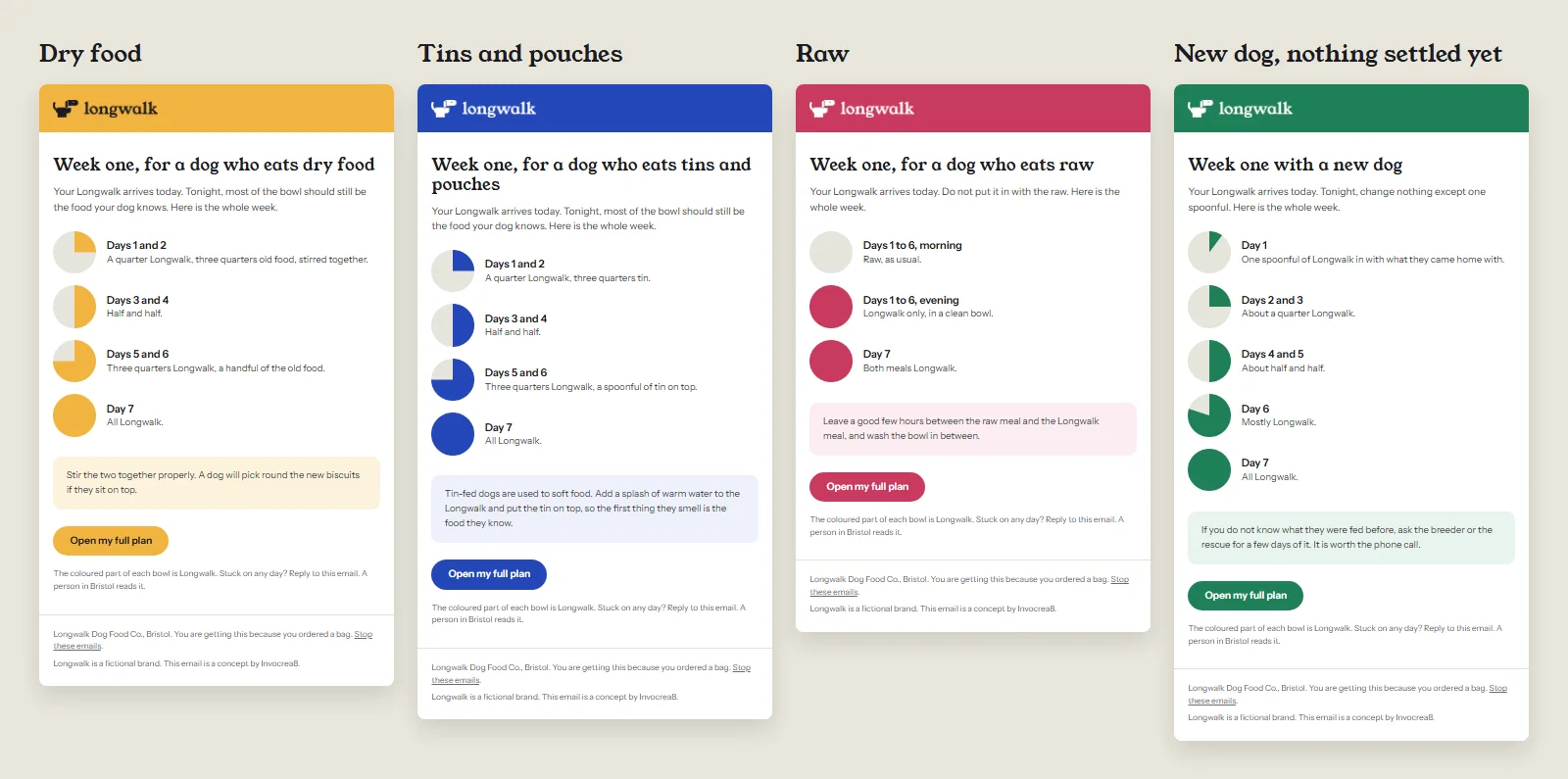
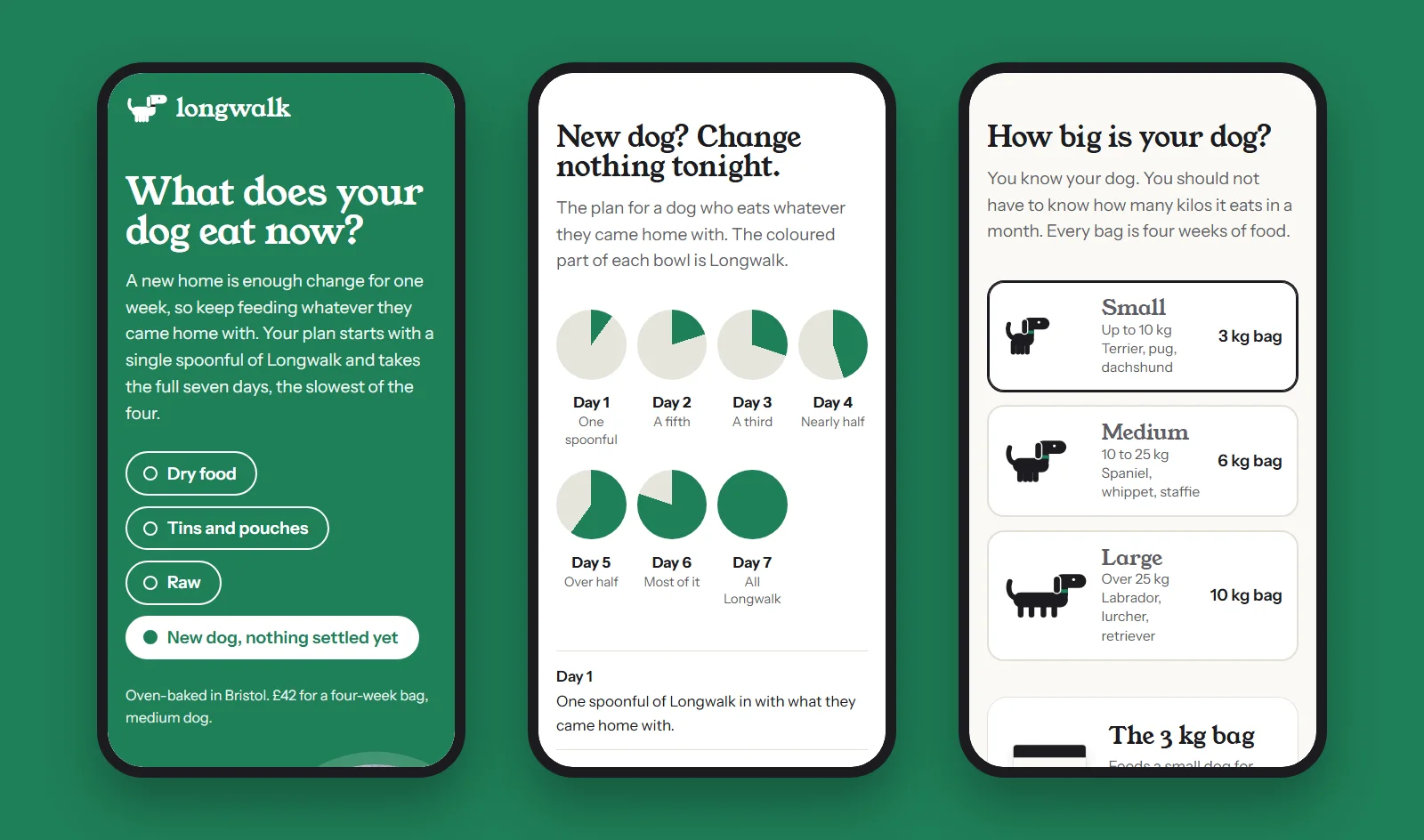
There are four plans, one for each kind of bowl. Every one takes seven days, and they differ in how the week is spent: dry food is mixed into the same bowl, tins stay on top, raw is kept to a separate meal, and a new dog starts with a single spoonful.
One brand, briefly
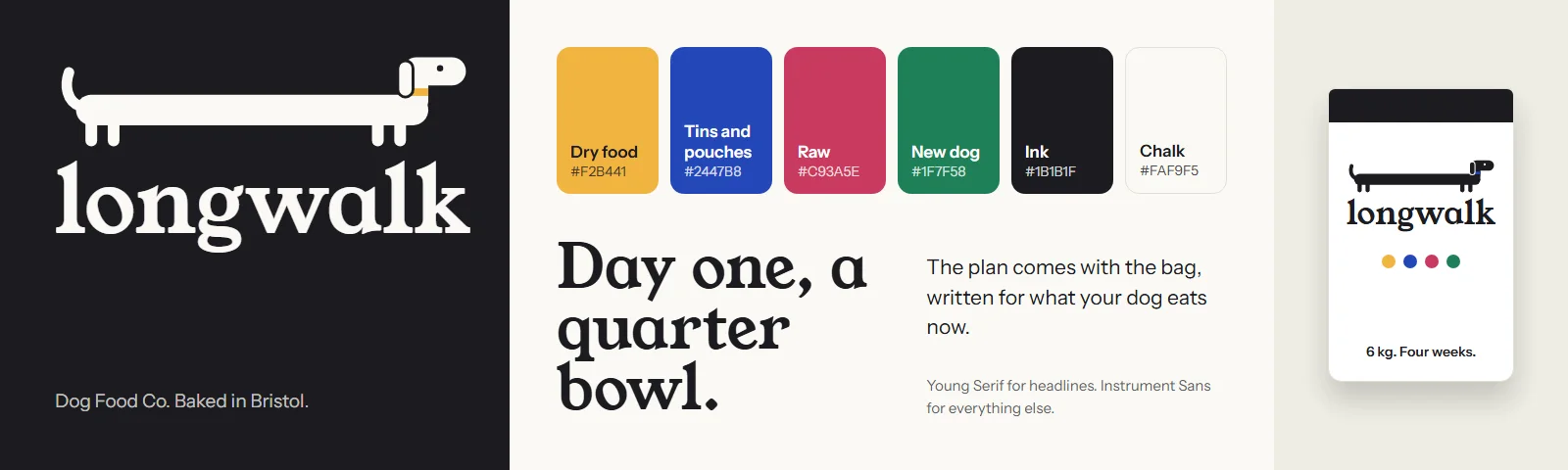
This is a marketing piece, so the brand is only as big as the campaign needs. Each of the four bowls owns a colour, and a page, an ad or an email takes the colour of the bowl it is talking to. You can tell which customer a piece is for before reading a word of it. The logo is a dog as long as the name, and its collar is the one part that changes colour.
The landing page
One page, one offer, two questions an owner can answer without thinking.
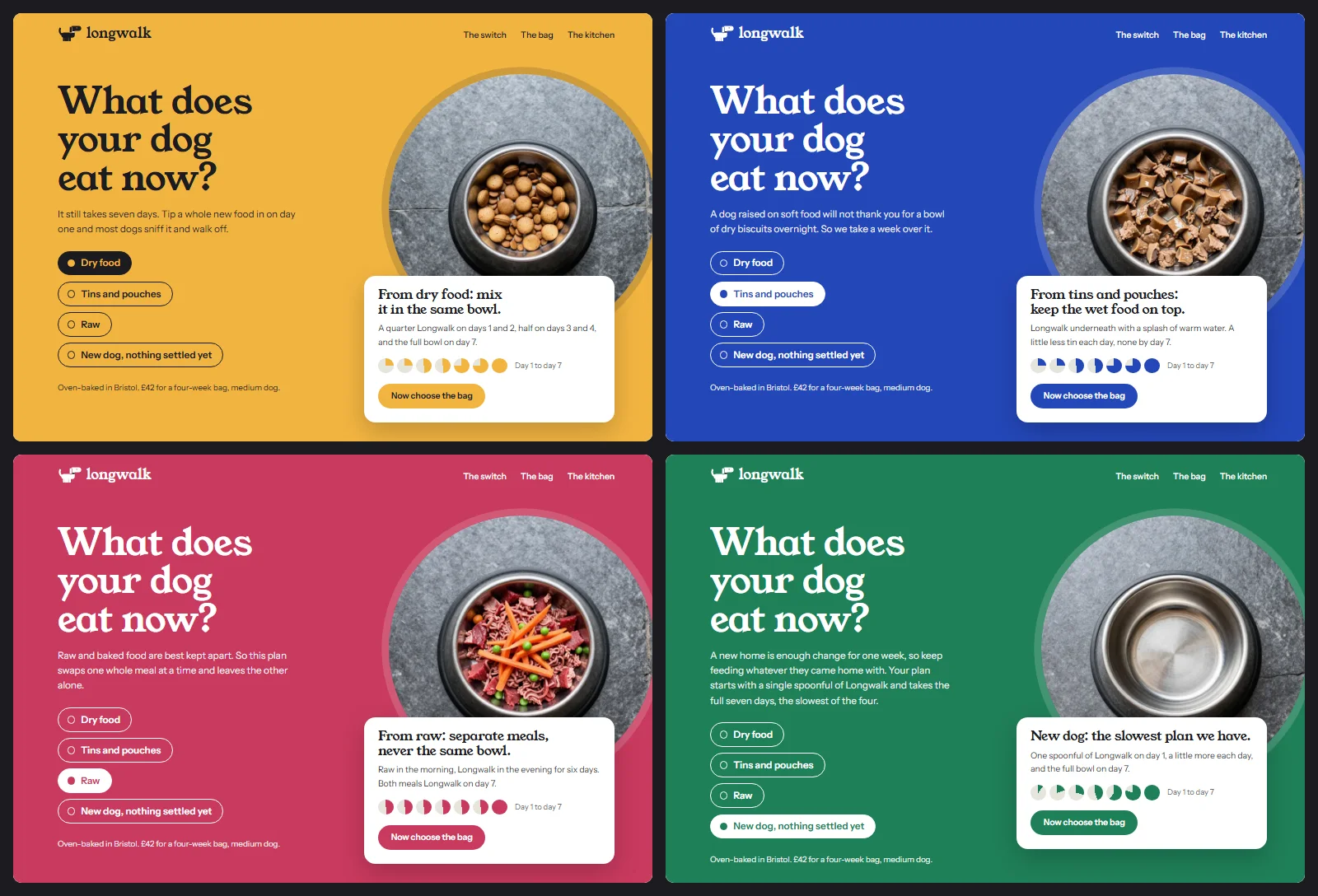
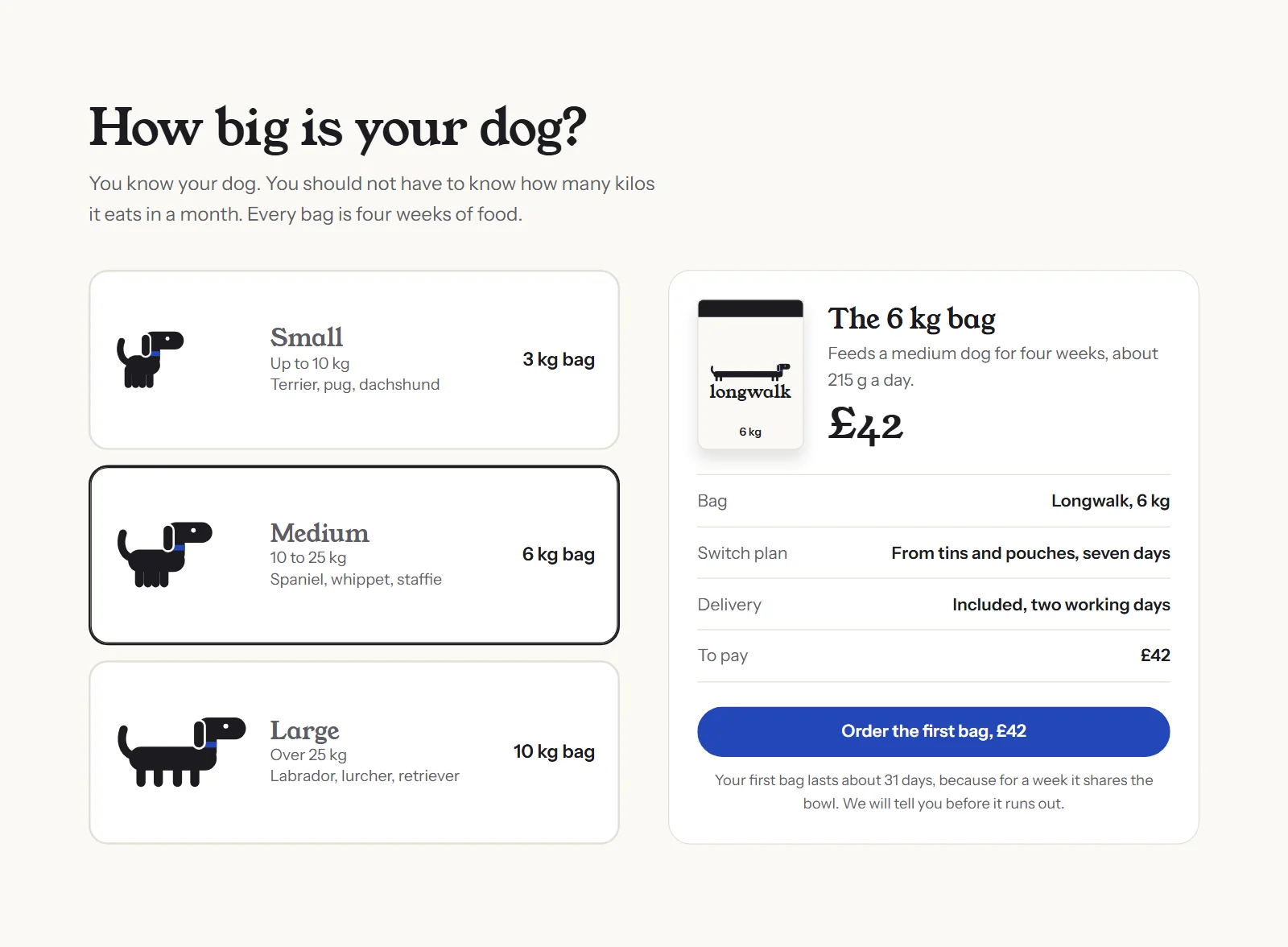
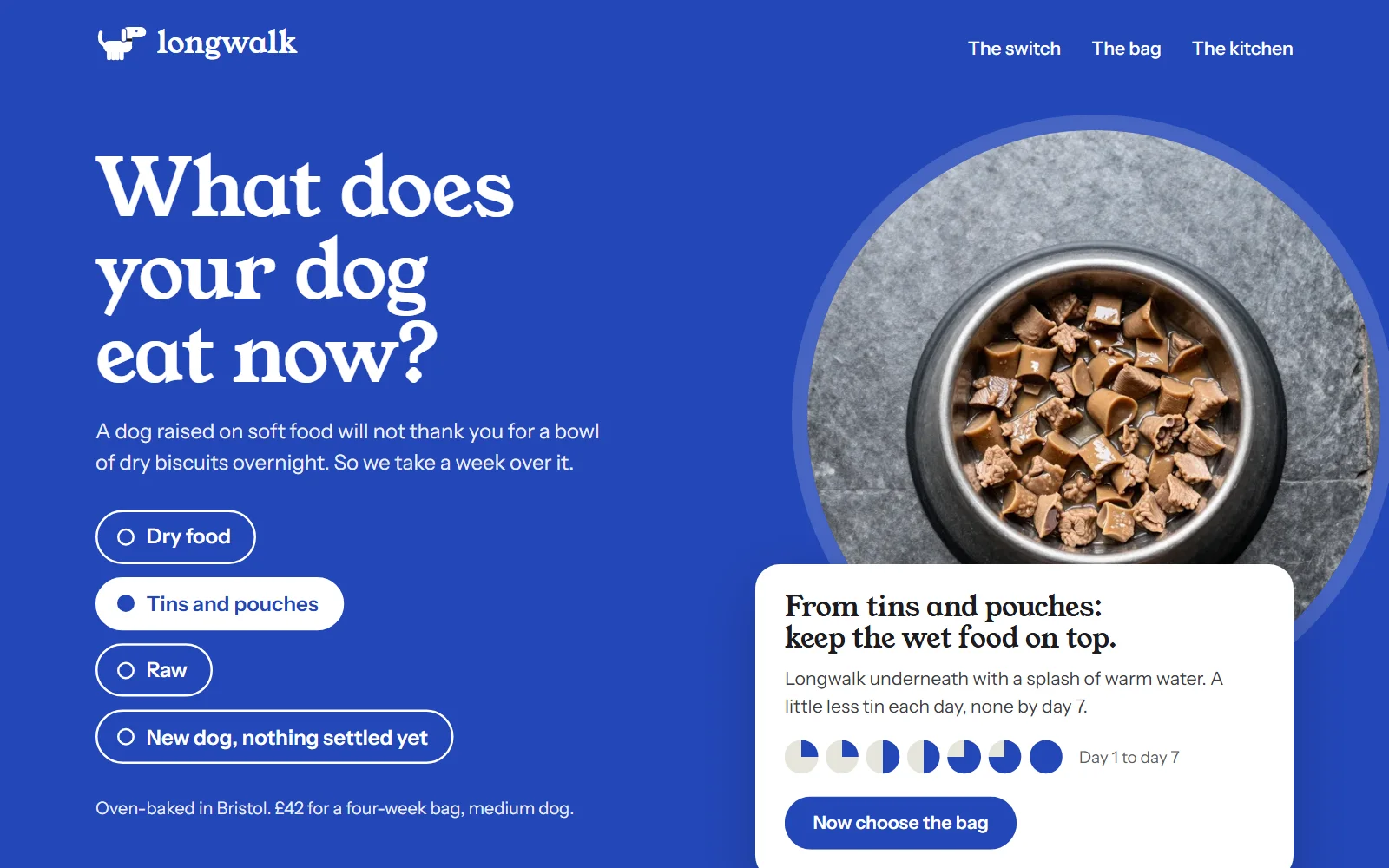
The hero asks what the dog eats now: dry food, tins and pouches, raw, or “new dog, nothing settled yet”. The answer changes the colour of the page, the copy under the headline and the switch plan shown, and that plan ships with the order. “Nothing settled yet” is a first-class answer, not a fallback. It gets its own two-sentence explainer and the slowest of the four plans, because a new owner is precisely the one who switches overnight.
The bag picker then asks how big the dog is instead of how many kilos to buy, because an owner knows their dog and has no idea how much it eats in a month. Small, medium or large sets the bag and the price: 3 kg at £26, 6 kg at £42 or 10 kg at £62, each one four weeks of food. Both answers go straight onto the order line.
The ads
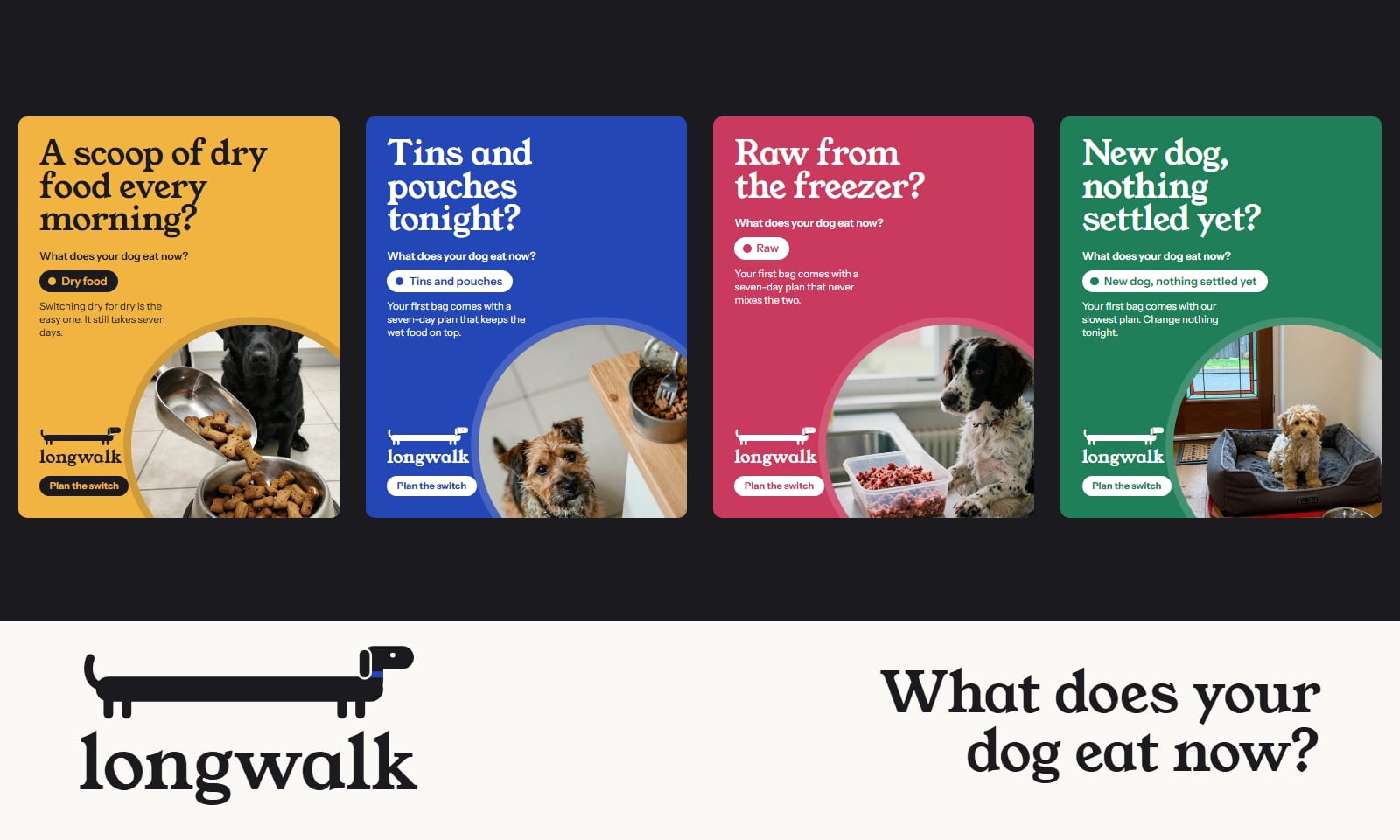
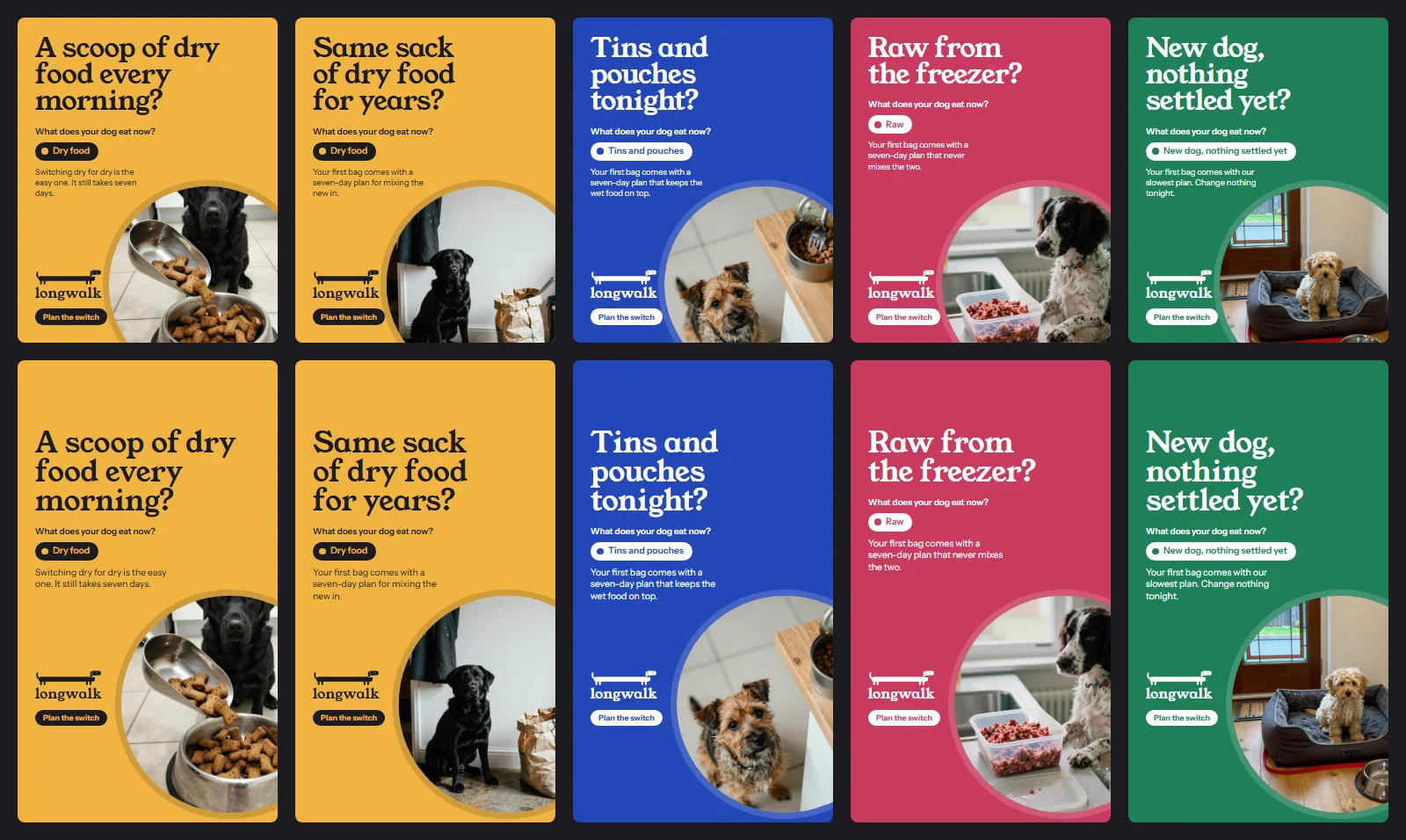
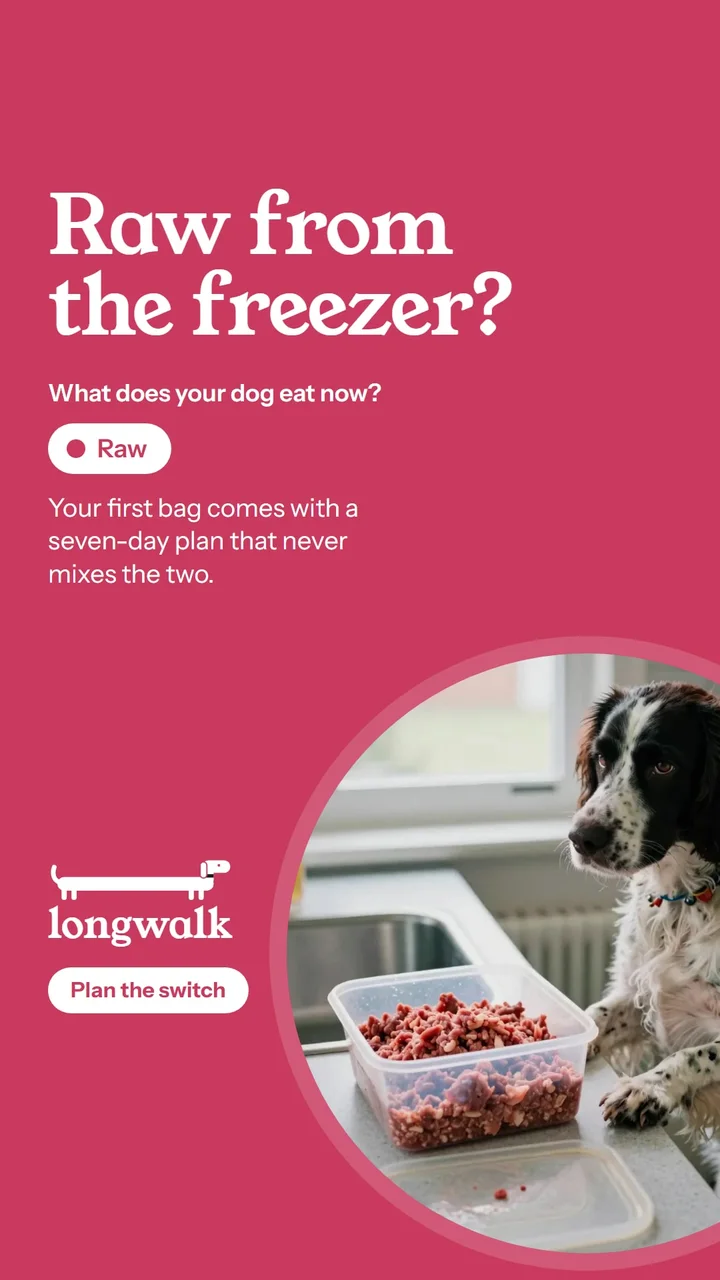
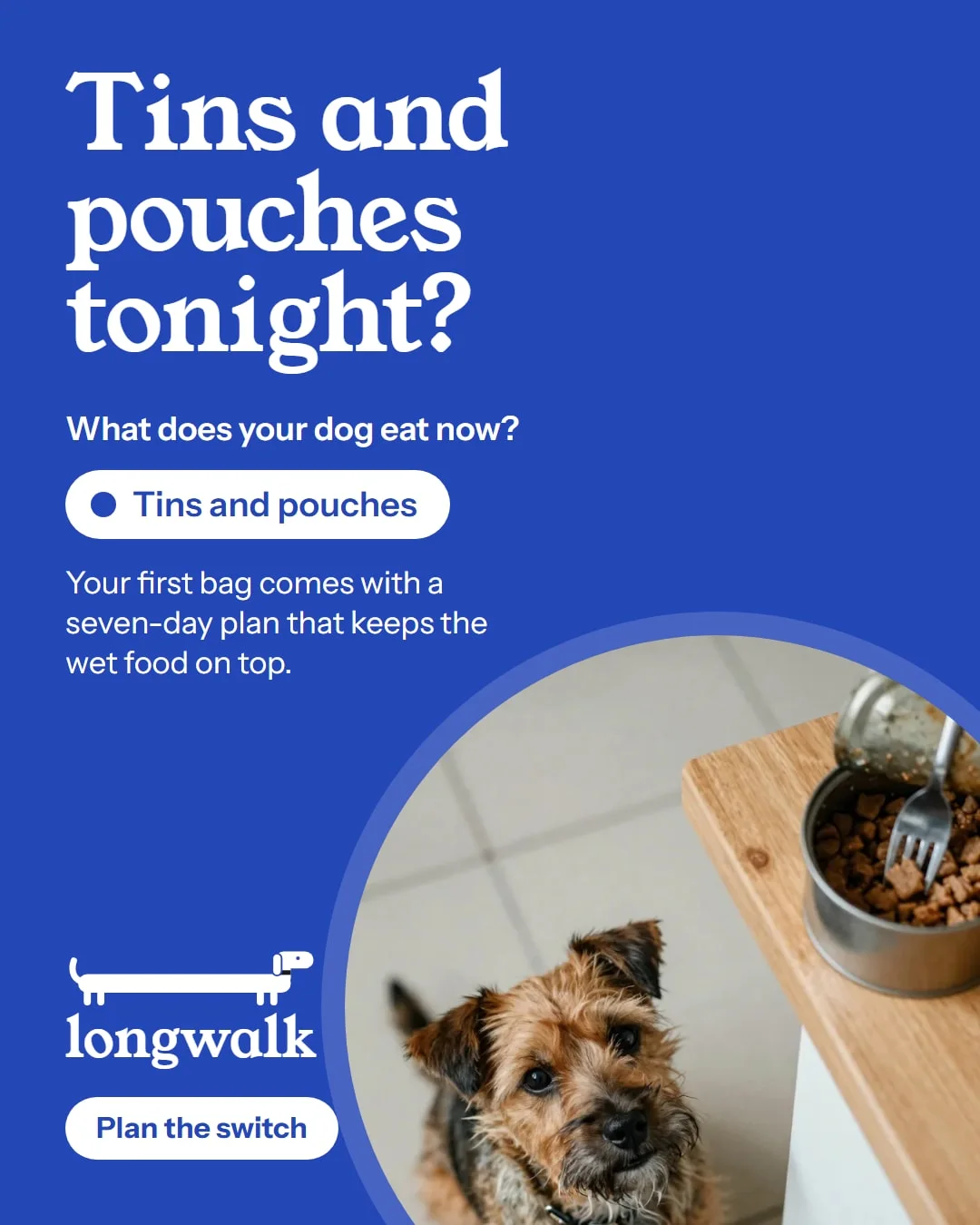
Five statics and two short video cuts, each built on one of the four bowls rather than on the bag. Dry food is the biggest group, so it gets two of the five. The hook is what the dog eats today, not the ingredients list: an owner who opens a tin every evening stops for a tin being opened.
Every ad carries the same question the landing page opens with, already answered for that bowl. The click lands on a page in the same colour, with the same answer picked, that finishes the sentence the ad started.
The welcome emails
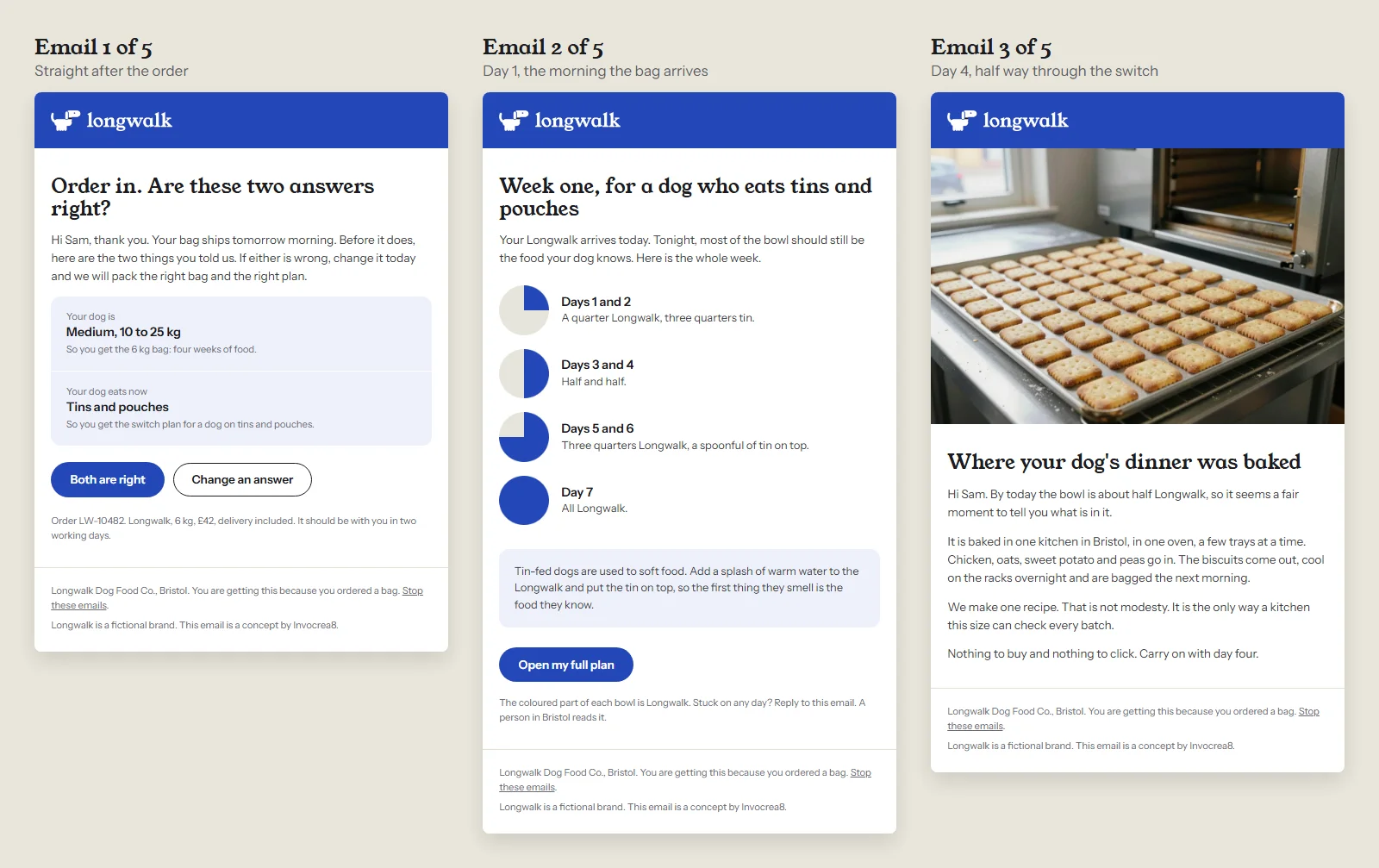
Five emails over the first four weeks, none of them a discount.
- Straight after the order. It repeats the dog’s size and current food back, so a wrong answer can be fixed before the bag ships.
- Day 1, the morning the bag arrives. The switch plan for the bowl they picked, and only that bowl.
- Day 4. The kitchen. By now the bowl is half Longwalk, which is when an owner wants to know what is in it.
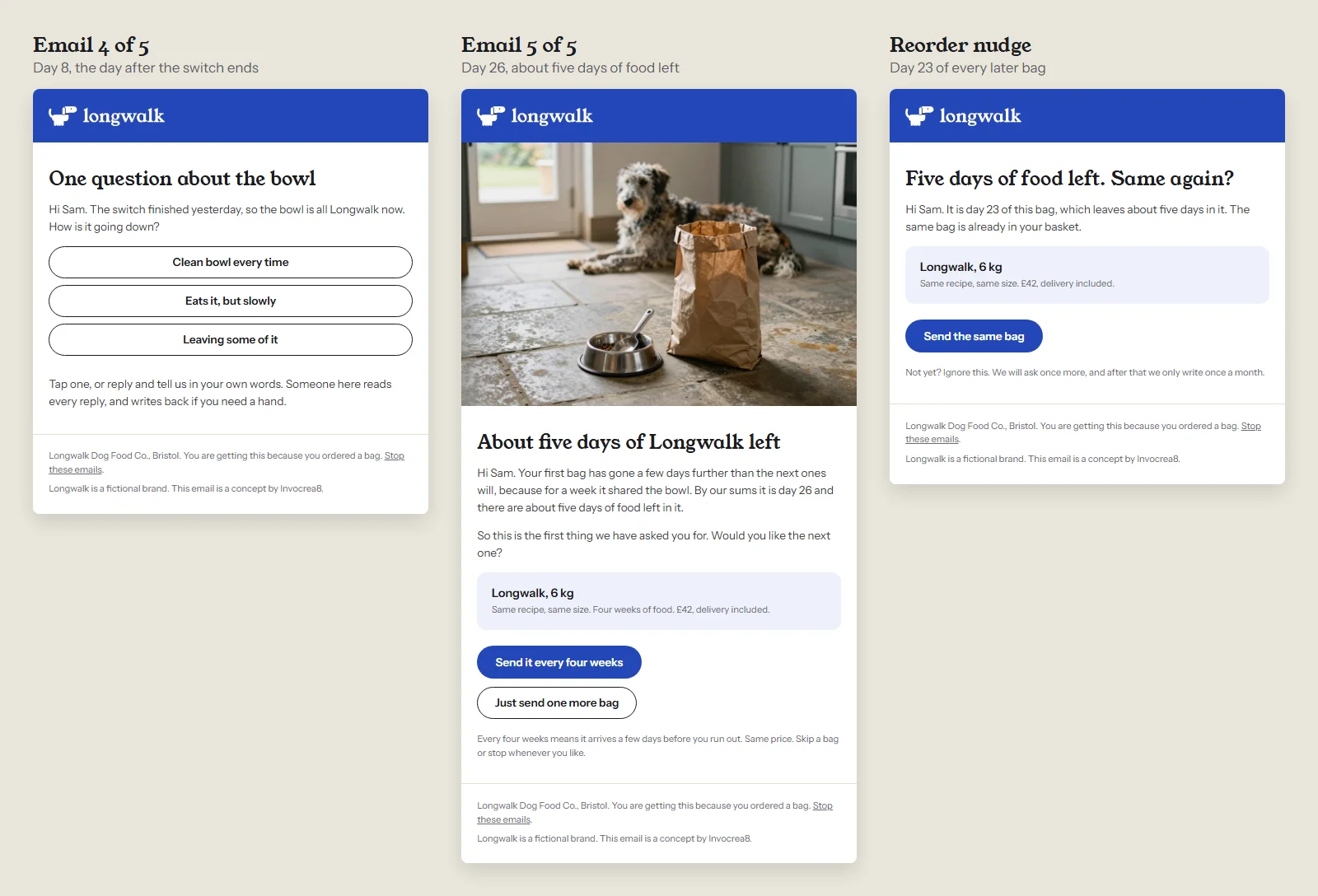
- Day 8. The switch finished yesterday. It asks one question and a person reads the reply.
- Day 26. The bag is running low. This is the first and only ask in the series, and the first time the four-week delivery is offered.
The second bag
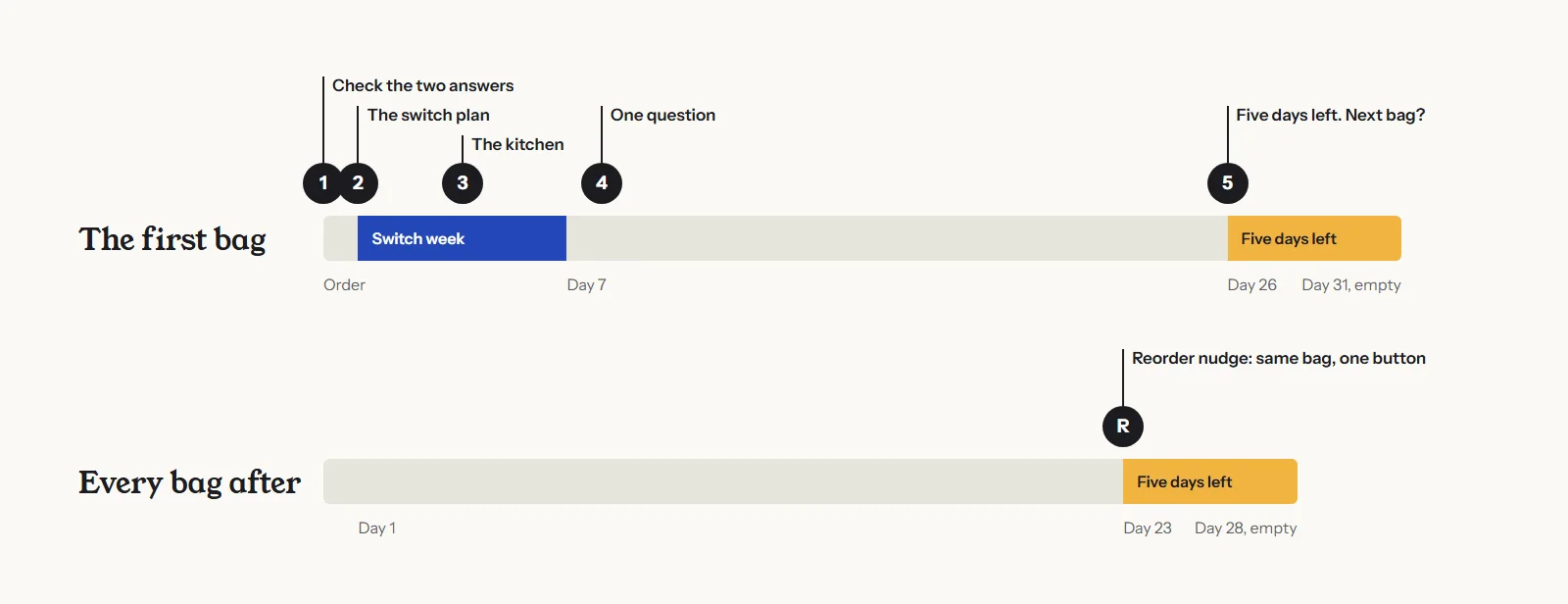
The reorder is timed off the bag, not off the calendar. Every bag is sized to feed that dog for four weeks, so the nudge goes five days before it runs out: day twenty-three, with the same recipe and the same bag size already chosen.
The first bag runs a few days longer, because for the first week it shares the bowl with the old food. So that one nudge moves to day twenty-six, and it is the fifth welcome email rather than a sixth message on the same day. A customer who ignores two nudges moves to a monthly note instead, rather than being emailed into unsubscribing.
The report
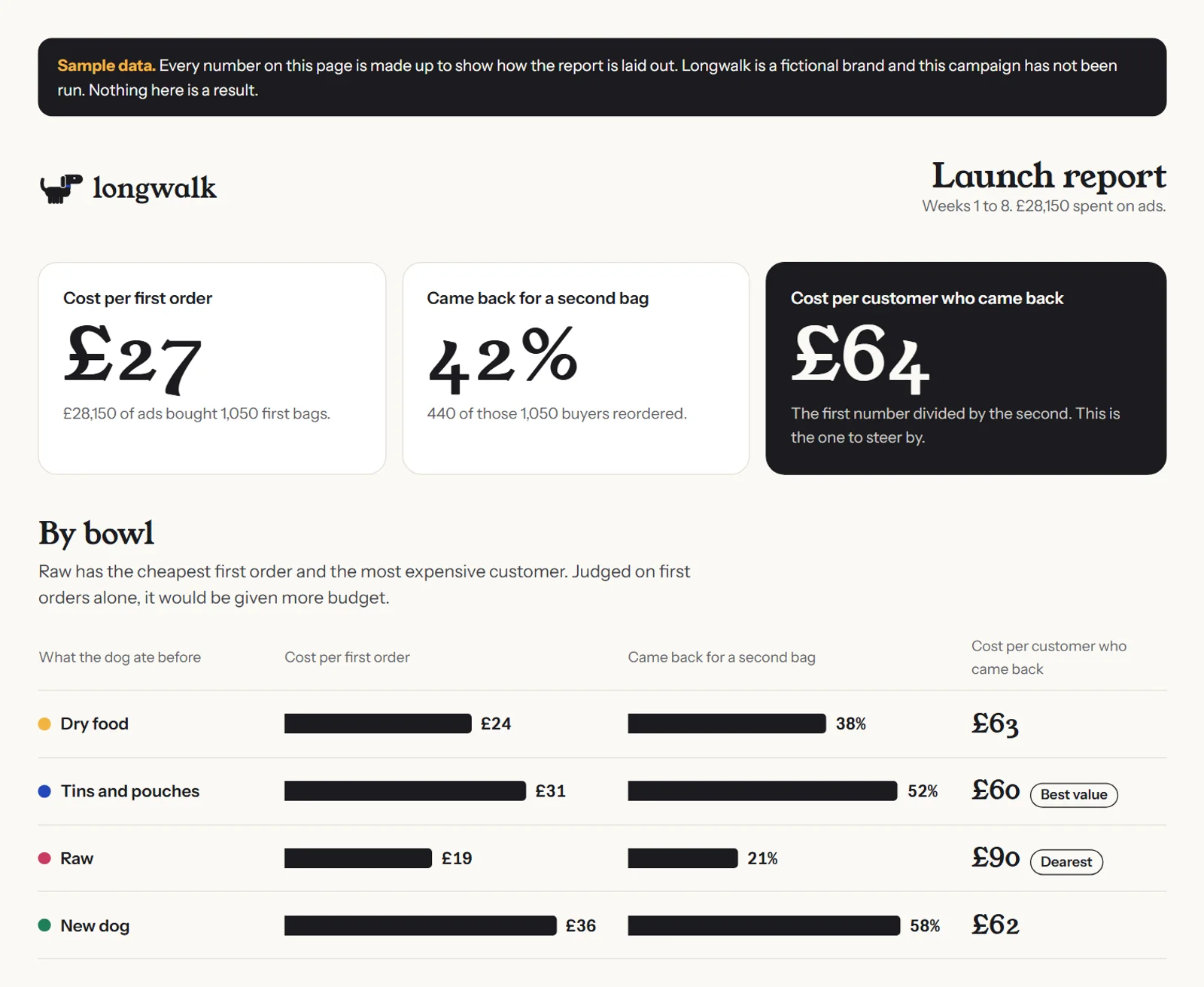
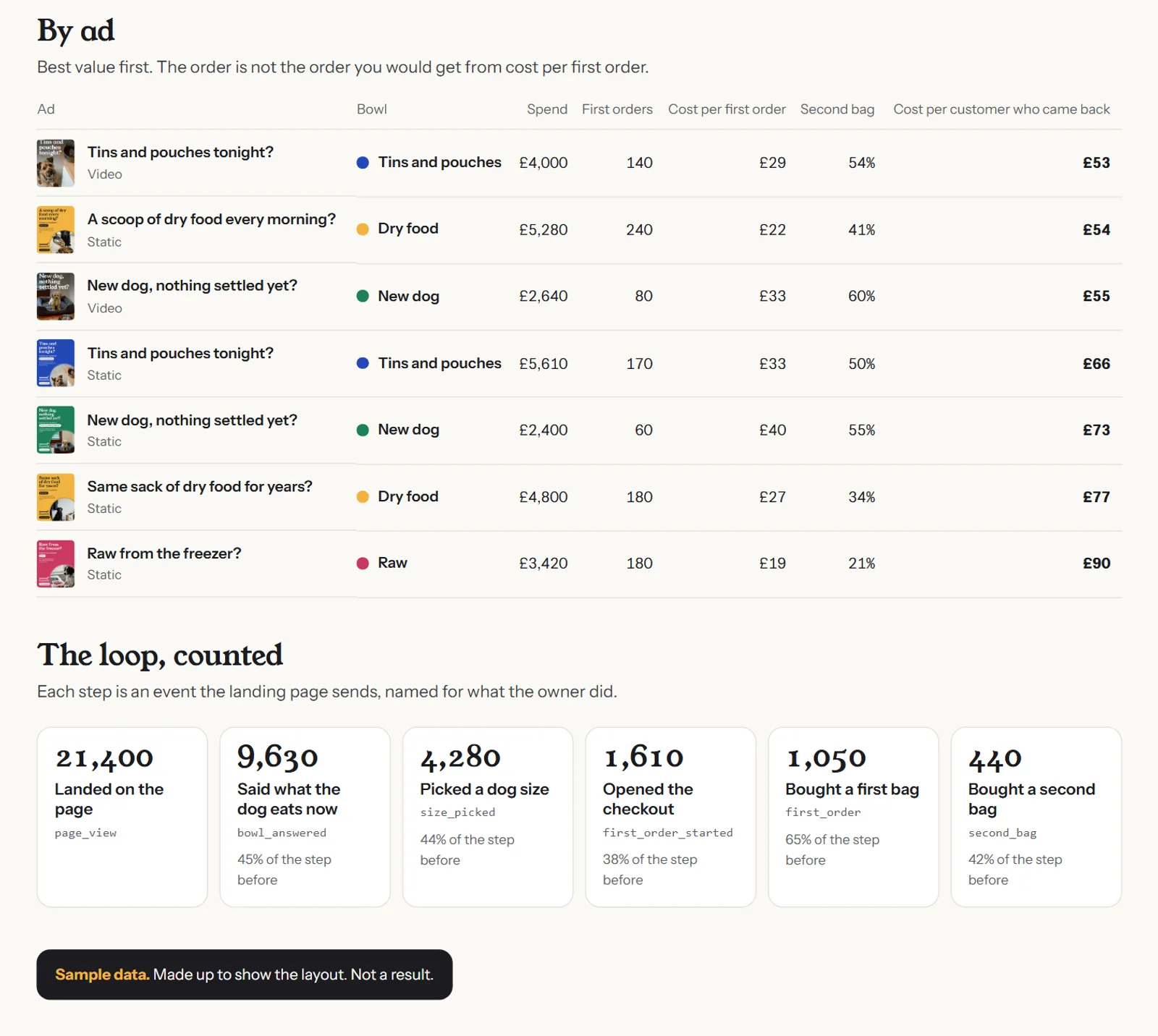
One page, showing cost per first order next to second-bag rate, together, because either number alone is a lie. Dividing the first by the second gives the number to steer by: what it costs to win a customer who came back.
The figures below are sample data, made up to show the layout. They are chosen to make the point the report exists for: the bowl with the cheapest first order can be the most expensive customer once you count who reordered.
What ships
- A landing page with the current-food question and the dog-size picker wired to the colour, the copy, the switch plan and the order line
- Ad creative: five static variations and two short video cuts, sized for feed, story and reel, with the source files
- A five-email welcome series and a reorder nudge, written and built as email HTML, with a version of the switch plan for each bowl
- List segmentation on dog size, current food and purchase count, so the questions the brand actually asks (what does the dog eat, how fast does a bag go, how many times have they bought) are answerable from day one
- Conversion events set up before any spend, and named for the loop rather than the platform defaults: the bowl answered, the size picked, the first order, the second bag
- A one-page reporting view showing cost per first order next to repeat rate
Why this matters
The reason this is worth building as one system rather than four purchases is that the four pieces are useless separately. Ads without the welcome sequence buy first orders at a loss. A welcome sequence without the switch plan nurtures a customer whose dog has already left the bowl. Segmentation without the two questions has nothing to segment on. Reporting that shows cost per acquisition without repeat rate tells a brand to spend more on the exact thing losing them money.
The same loop lifts onto anything bought more than once: coffee, skincare, supplements, printer ink, spice blends, dry cleaning. The variable is the question that has to be asked before the first purchase to stop the first experience being a bad one. For dog food it is the switch. Every consumable has one, and most brands bury it in the small print.